
Sundanese
They call themselves ᮅᮛᮀ ᮞᮥᮔ᮪ᮓ (Urang Sunda)
The native people of western Java, Indonesia, known for their language and traditions
The Sundanese are an Austronesian people native to the western part of Java island in Indonesia, especially in West Java and Banten. With a population of about 42–45 million, they are Indonesia's second largest ethnic group. They speak the Sundanese language and are known for their distinct culture, traditional arts, and strong community ties.
Who are the Sundanese?
The Sundanese are the native people of western Java, Indonesia. Their identity is rooted in the Sundanese language, shared customs, and a strong sense of community. Most Sundanese live in West Java and Banten, but there are also communities in other parts of Indonesia and a small diaspora abroad. Their culture values harmony with nature, respect for elders, and a tradition of oral storytelling. The Sundanese are known for their music, dance, and cuisine, which reflect their agricultural roots and close-knit village life.
Where do the Sundanese live?
The Sundanese homeland covers the lush, volcanic highlands and fertile plains of western Java, especially in the provinces of West Java and Banten. This region is marked by mountains, hills, and rivers, with a climate suitable for rice farming. The landscape has shaped Sundanese village life, with settlements often nestled among rice fields and forests. Geographic isolation between valleys and hills has helped preserve local dialects and customs. The natural beauty of the Parahyangan highlands is celebrated in Sundanese legends and arts.
What language do the Sundanese speak?
Sundanese is an Austronesian language spoken by tens of millions, making it one of Indonesia’s most widely used regional languages. It has several dialects, with the most refined spoken in the Priangan region. While the Latin script is now standard, efforts are underway to revive the traditional Sundanese script. The language is closely related to Malay and Javanese and features levels of speech to show respect. Sundanese remains vital in daily life, education, and the arts.
How do the Sundanese live?
Traditionally, the Sundanese are rice farmers, practicing both wet and dry rice cultivation. Villages are often small and self-sufficient, with houses built from bamboo and wood, raised above the ground. Sundanese people also engage in crafts, trade, and increasingly, wage work in cities. Their cuisine is known for fresh vegetables and spicy sambal. Tools and utensils are often handmade, and markets play a central role in economic and social life. In modern times, many Sundanese work in education, entertainment, and other urban professions.
How is Sundanese society organised?
Sundanese society is organized around the nuclear family, but extended kinship ties remain important. Villages are led by elders or elected heads, and decisions are made through consensus. Social life is egalitarian, with less rigid hierarchy than some neighboring cultures. Marriage is usually monogamous, and traditional ceremonies are marked by music and dance. Clans and lineages exist, but village and family bonds are stronger. Respect for elders and communal cooperation are key values.



What do the Sundanese believe?
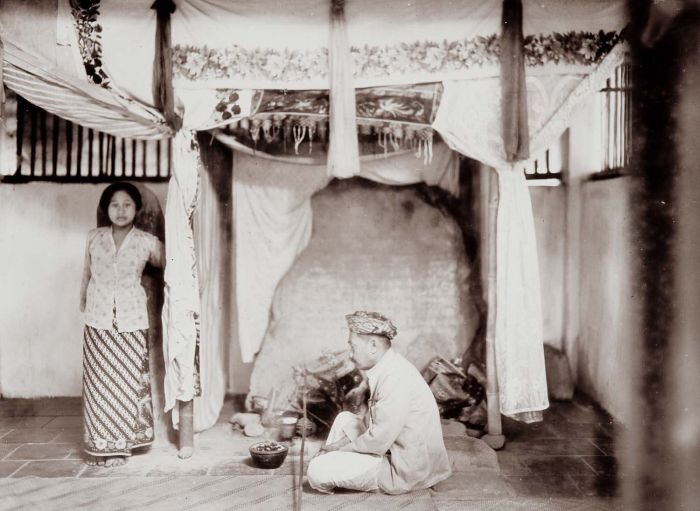
Most Sundanese today are Sunni Muslims, but their culture retains elements of earlier beliefs known as Sunda Wiwitan, which honor ancestral and natural spirits. Rituals linked to rice farming, such as offerings to the rice goddess Nyai Pohaci, remain important in some areas. Music, dance, and storytelling are central to ceremonies and festivals. Traditional arts include angklung (bamboo music), wayang golek (puppet theater), and batik. Dress varies, but traditional attire is worn for special occasions.
The history of the Sundanese
The Sundanese trace their origins to Austronesian migrations and ancient kingdoms such as Tarumanagara and Sunda. Hindu and Buddhist influences arrived early but blended with local beliefs. The Sunda Kingdom flourished until the 16th century, when Islamic sultanates rose in the region. Dutch colonial rule brought economic changes and Christian missions, but Sundanese society remained rooted in village life. Throughout history, the Sundanese have valued independence, adapting to outside influences while preserving their language and traditions.
Sundanese life today
Today, the Sundanese are Indonesia’s second largest ethnic group, with most living in West Java and Banten. Urbanization and migration have brought many to cities and other islands. While most are Muslim, small communities maintain traditional beliefs. The Sundanese language and arts are promoted in schools and media, and there are efforts to revive the Sundanese script. Economic pressures and modernization challenge traditional ways, but Sundanese identity remains strong.
Questions people ask about the Sundanese
Where do the Sundanese live?
The Sundanese live in Indonesia, Malaysia, Singapore and Japan, in the western Java, especially West Java and Banten provinces.
How many Sundanese people are there?
Our sources give the Sundanese population as about 42,000,000 (2010 estimate); Wikidata: 45,000,000. Counts of peoples vary with who is counted and when.
What language do the Sundanese speak?
The Sundanese speak Sundanese, which belongs to the Austronesian family of languages.
How do the Sundanese make a living?
The Sundanese are known for settled farming, towns and wage work and craft and trade. Like most peoples, they combine several ways of making a living, and these have changed over time.
Sources and further reading
- Sundanese people on WikipediaEncyclopedia
- Encyclopaedia BritannicaArticle
- More photos on Wikimedia CommonsPhotos
- Wikidata recordOpen data
This page was written with AI assistance from the sources above and checked automatically before publishing. It may contain mistakes, and it is no substitute for hearing from the Sundanese themselves. If something is wrong, tell us. Last refreshed 2026-10-02.
Neighbours in Indonesia
All peoples of Indonesia MalaysOrang Melayu
🇲🇾 Malaysia and 4 moreAustronesian people of the Malay Peninsula, Sumatra, Borneo and nearby islands
About 30 million, Austronesian
MalaysOrang Melayu
🇲🇾 Malaysia and 4 moreAustronesian people of the Malay Peninsula, Sumatra, Borneo and nearby islands
About 30 million, Austronesian
 Minangkabaubangso Minangkabau
🇮🇩 Indonesia and 3 moreMatrilineal Muslim society from the highlands of West Sumatra
About 6.6 million, Austronesian
Minangkabaubangso Minangkabau
🇮🇩 Indonesia and 3 moreMatrilineal Muslim society from the highlands of West Sumatra
About 6.6 million, Austronesian
 Balineseanak Bali
🇮🇩 IndonesiaHindu-majority people of Bali, known for art, dance, and water-temple farming
About 3.9 million, Austronesian
Balineseanak Bali
🇮🇩 IndonesiaHindu-majority people of Bali, known for art, dance, and water-temple farming
About 3.9 million, Austronesian
 TorajaTo Raya
🇮🇩 IndonesiaHighland people of South Sulawesi known for elaborate funerals and tongkonan houses
About 1.1 million, Austronesian
TorajaTo Raya
🇮🇩 IndonesiaHighland people of South Sulawesi known for elaborate funerals and tongkonan houses
About 1.1 million, Austronesian
Other Austronesian speakers
See them all Sama-BajauSama
🇵🇭 Philippines and 3 moreSeafaring Austronesian people of the southern Philippines, Borneo, and eastern Indonesia
About 1.3 million, Austronesian
Sama-BajauSama
🇵🇭 Philippines and 3 moreSeafaring Austronesian people of the southern Philippines, Borneo, and eastern Indonesia
About 1.3 million, Austronesian
 MadureseOrèng Mâdhurâ
🇮🇩 Indonesia and 2 moreCattle herders and satay makers from Madura Island and eastern Java
About 7.2 million, Austronesian
MadureseOrèng Mâdhurâ
🇮🇩 Indonesia and 2 moreCattle herders and satay makers from Madura Island and eastern Java
About 7.2 million, Austronesian
 IbanDayak Iban
🇲🇾 Malaysia and 2 moreDayak people of northwestern Borneo, known for longhouses and weaving
About 740,000, Austronesian
IbanDayak Iban
🇲🇾 Malaysia and 2 moreDayak people of northwestern Borneo, known for longhouses and weaving
About 740,000, Austronesian
 ChamorroChamoru
🇺🇸 United States and 2 moreIndigenous people of the Mariana Islands, mainly Guam and Northern Marianas
About 168,000, Austronesian
ChamorroChamoru
🇺🇸 United States and 2 moreIndigenous people of the Mariana Islands, mainly Guam and Northern Marianas
About 168,000, Austronesian