
Tocharians of Karasahr
They call themselves Ārśi
Ancient Indo-European people of Karasahr in the Tarim Basin, Xinjiang
The Tocharians of Karasahr, also known as Ārśi or Agni, were an Indo-European people who lived in the Tarim Basin, in what is now Xinjiang, China. They are known for their Tocharian A language and their role as a Buddhist kingdom along the Silk Road. Their culture faded after conquest by the Uyghurs in the 9th century.
- Known as Ārśi or Agni in ancient times
- Spoke Tocharian A, an Indo-European language
- Converted to Buddhism and cremated their dead
- Famous for grape wine and music
- Homeland near Lake Bosten, a major oasis in Xinjiang
Who were the Tocharians of Karasahr?
The Tocharians of Karasahr, known in their own language as Ārśi, formed a distinct Indo-European community in the Tarim Basin. Their city was a key stop on the Silk Road, connecting China and Central Asia. They were held together by a shared language, Tocharian A, and a culture that blended local traditions with influences from India and Iran. Over time, they became known for their Buddhist beliefs and their role as a regional kingdom, often interacting with powerful neighbors such as the Han and Tang dynasties.
Where did the Tocharians of Karasahr live?
Karasahr was located on the northern edge of the Taklamakan Desert, near the fertile lands around Lake Bosten in Xinjiang. The area is marked by rivers and lakes, making it a rare oasis in a region otherwise dominated by desert and mountains. This geography made Karasahr an important hub for trade and travel, as well as a center for agriculture and fishing. The surrounding mountains and water sources provided both natural defenses and resources for the people.
What language did the Tocharians of Karasahr speak?
The Tocharians of Karasahr spoke Tocharian A, an Indo-European language rediscovered in the early 20th century. Their script was similar to those used in India. Over time, their language was influenced by contact with speakers of Sanskrit, Pali, and other Indo-Iranian languages. By the 9th century, Tocharian A faded from use, replaced by Uyghur Turkic languages after conquest.
How did the Tocharians of Karasahr live?
The Tocharians of Karasahr lived by farming crops such as rice, millet, wheat, and barley, and raising animals like camels, horses, cows, and sheep. They also fished in the abundant waters of Lake Bosten and nearby rivers. Silk-worms were raised, though the silk was used for padding rather than weaving. The people enjoyed grape wine and were known for their music and crafts. Their town was surrounded by walls and had several walled settlements.
How was Tocharians of Karasahr society organised?
Historical records describe the Tocharians as living in households within walled towns. Marriage customs were said to be similar to those of the Chinese. The dead were cremated and then buried, and mourning lasted seven days. Men wore trimmed hair as decoration. Their society was organized under local kings, with a tradition of sending envoys and tribute to neighboring powers. Decision-making was likely centered on the royal court and local leaders.


What did the Tocharians of Karasahr believe?
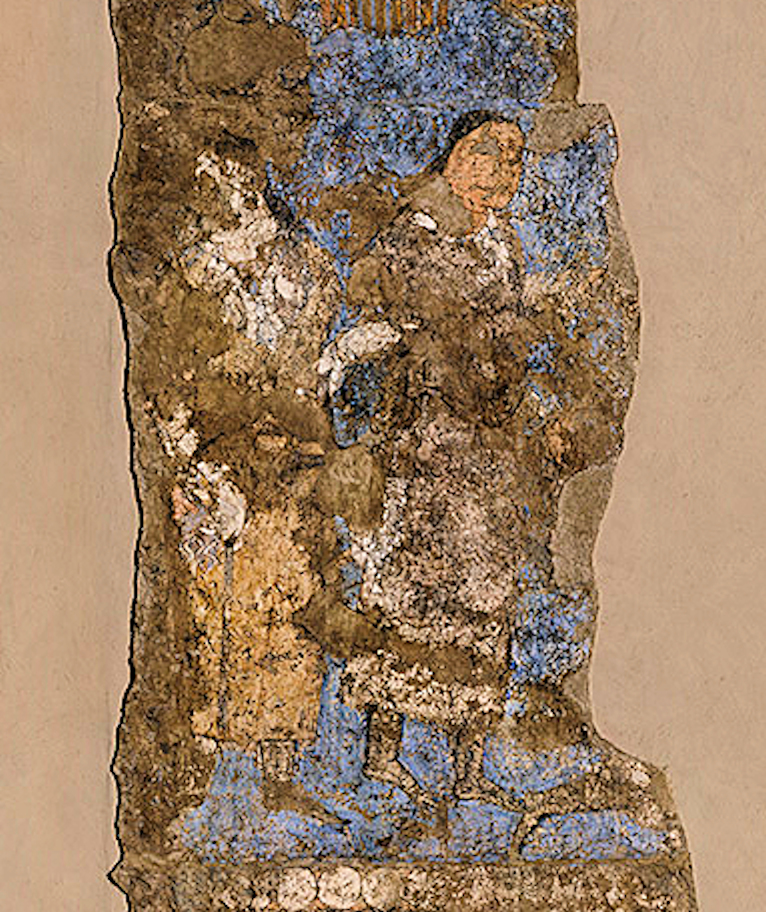
The Tocharians practiced Buddhism, celebrating key days with abstinence and penance, following the teachings of the Buddha. They also revered 'Heavenly Gods' and maintained earlier local beliefs. Cremation was the norm for funerals. Music played a significant role in their culture, and they were fond of grape wine. Their written language and script showed strong Indian influence.
The history of the Tocharians of Karasahr
Karasahr, or Ārśi, was a prominent kingdom in the Tarim Basin, mentioned in Han dynasty records as Yanqi. It became a tributary of the Han and later the Tang dynasty, but also faced invasions and uprisings. The city was a Buddhist center, known as Agni in Sanskrit sources. In the 9th century, the area was conquered by the Uyghur Khaganate, leading to the decline of the Tocharian language and culture. Over the centuries, Karasahr became known by its Turkic name and was ruled by Mongol and later Chinese powers.
What became of the Tocharians of Karasahr?
The original Tocharian people of Karasahr no longer exist as a distinct group. The modern town is home to Han, Hui, Uyghur, Mongol, and other communities. The ancient Tocharian language and culture have disappeared, but archaeological and linguistic research continues to shed light on their history. Karasahr remains a diverse town in Xinjiang, with a predominately Muslim population.
Questions people ask about the Tocharians of Karasahr
Where did the Tocharians of Karasahr live?
They lived in Karasahr, on the northern edge of the Taklamakan Desert in the Tarim Basin, Xinjiang, China.
What language did they speak?
They spoke Tocharian A, an Indo-European language with a script similar to those used in India.
How did they make a living?
They farmed crops like rice and wheat, raised animals, fished in Lake Bosten, and made crafts.
What religion did they follow?
They practiced Buddhism and also revered 'Heavenly Gods', with cremation as a funeral custom.
Do the Tocharians of Karasahr still exist today?
No, the original Tocharian people and their language disappeared after the 9th century following Uyghur conquest.
Sources and further reading
This page was written with AI assistance from the sources above and checked automatically before publishing. It may contain mistakes, and it is no substitute for hearing from the Tocharians of Karasahr themselves. If something is wrong, tell us. Last refreshed 2026-10-02.
Neighbours in China
All peoples of China Uyghursئۇيغۇرلار / Уйғурлар / Uyghurlar
🇨🇳 China and 12 moreA Turkic people of Xinjiang, China, with deep roots in Central Asia
About 12 million, Turkic (Karluk branch)
Uyghursئۇيغۇرلار / Уйғурлар / Uyghurlar
🇨🇳 China and 12 moreA Turkic people of Xinjiang, China, with deep roots in Central Asia
About 12 million, Turkic (Karluk branch)
 Sherpaཤར་པ།
🇳🇵 Nepal and 3 moreMountain people of the Himalayas, renowned for guiding climbers
About 520,000, Tibeto-Burman
Sherpaཤར་པ།
🇳🇵 Nepal and 3 moreMountain people of the Himalayas, renowned for guiding climbers
About 520,000, Tibeto-Burman
 Yao
🇨🇳 China and 3 moreMountain peoples of southern China and Southeast Asia, known for diverse languages and traditions
About 4 million, Hmong-Mien, Tai–Kadai, Sinitic
Yao
🇨🇳 China and 3 moreMountain peoples of southern China and Southeast Asia, known for diverse languages and traditions
About 4 million, Hmong-Mien, Tai–Kadai, Sinitic
 Lisuꓡꓲ‐ꓢꓴ
🇨🇳 China and 3 moreTibeto-Burman people of the mountains in China, Myanmar, Thailand, and India
About 1.4 million, Tibeto-Burman
Lisuꓡꓲ‐ꓢꓴ
🇨🇳 China and 3 moreTibeto-Burman people of the mountains in China, Myanmar, Thailand, and India
About 1.4 million, Tibeto-Burman
Other Indo-European speakers
See them all Sicels
🇮🇹 ItalyIron Age tribe of eastern Sicily known for their language and cults
Historical, Indo-European
Sicels
🇮🇹 ItalyIron Age tribe of eastern Sicily known for their language and cults
Historical, Indo-European
 KrasniqiKrasniqë
🇦🇱 Albania and 2 moreA historical Albanian tribe from the Accursed Mountains and Gjakova highlands
Indo-European
Hoti
🇦🇱 Albania and 1 moreA historic Albanian tribe of the Malësia region, now in Albania and Montenegro
Indo-European
KrasniqiKrasniqë
🇦🇱 Albania and 2 moreA historical Albanian tribe from the Accursed Mountains and Gjakova highlands
Indo-European
Hoti
🇦🇱 Albania and 1 moreA historic Albanian tribe of the Malësia region, now in Albania and Montenegro
Indo-European
 Dushmani
🇦🇱 AlbaniaA former tribal group from northern Albania, known for their strict customary law
Historical, Indo-European
Dushmani
🇦🇱 AlbaniaA former tribal group from northern Albania, known for their strict customary law
Historical, Indo-European