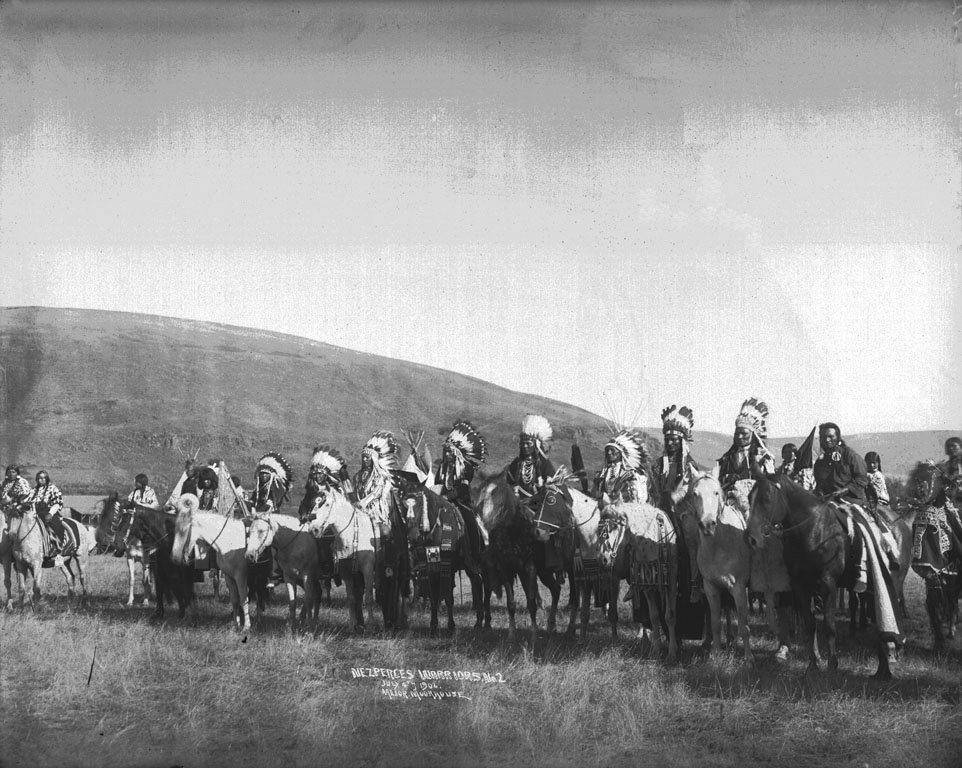
Nez Perce
They call themselves nimíipuu
Plateau people of Idaho known for salmon fishing and Appaloosa horses
The Nez Perce, or nimíipuu, are an Indigenous people of the southeastern Columbia River Plateau, mainly in Idaho. Numbering over 3,500 today, they are known for their salmon fisheries, Appaloosa horse breeding, and a strong tribal government. Their reservation is in Idaho, but their ancestral lands once spanned parts of Washington, Oregon, and Montana.
- Known for breeding the Appaloosa horse
- Operate salmon hatcheries and fisheries
- Reservation in Idaho with tribal government
- Some still speak the Nez Perce language
- Population over 3,500 (2021)
Who are the Nez Perce?
The Nez Perce, or nimíipuu, are an Indigenous people whose name means 'we, the people' in their own language. They are part of the Sahaptian language group and have lived in the Columbia River Plateau for at least 11,500 years. Their community is held together by a shared language, history, and cultural practices, including salmon fishing and horse breeding. Today, they maintain a distinct identity and self-government through the Nez Perce Tribal Executive Committee.
Where do the Nez Perce live?
The Nez Perce homeland centers on the southeastern Columbia River Plateau, especially in present-day Idaho. Historically, their territory covered parts of Idaho, Washington, Oregon, and Montana, including river valleys and mountain regions. The land provided salmon, game, and roots. Today, they live mainly on a reservation in Idaho, which is only a small part of their original territory.
What language do the Nez Perce speak?
The Nez Perce speak Nimiipuutímt, a Sahaptian language of the Plateau Penutian family. Some community members still speak the language, though English is also widely used. Efforts to preserve and revitalize Nimiipuutímt continue through tribal programs and education.
How do the Nez Perce live?
Traditionally, the Nez Perce relied on fishing, especially for salmon, as well as hunting, gathering, and some farming. They bred the Appaloosa horse, which became central to their culture and economy. Today, they manage salmon hatcheries, lease land, and operate casinos, clinics, and other enterprises. Many also work in wage jobs or crafts, balancing modern livelihoods with traditional practices.
How is Nez Perce society organised?
Nez Perce society was organized into regional bands and villages, with kinship and cooperation at the core. Families moved seasonally to follow resources. Leadership was often based on respect and consensus, with chiefs and councils guiding decisions. Marriage and alliances with neighboring peoples were common, and the community remains close-knit today.


![TITLE: The old-time warrior--Nez Percé CALL NUMBER: LOT 12325-C <item> [P&P] REPRODUCTION NUMBER: LC-USZ62-101259 (b&w film copy neg.) SUMMARY: Nez Percé man, wearing loin cloth and moccasins, on horseback. MEDIUM:](https://thumb.wikimedia.org/wikipedia/commons/thumb/6/6a/Nez_Perce_warrior_on_horse.jpg/960px-Nez_Perce_warrior_on_horse.jpg)
What do the Nez Perce believe?
The Nez Perce practice a mix of traditional beliefs, including the Seven Drum (Walasat) religion, and Christianity. Animism, or belief in the spiritual presence of natural elements, is also important. Rituals, music, and art are part of community life. Salmon and the land hold deep spiritual meaning, reflected in ceremonies and daily practices.
The history of the Nez Perce
The Nez Perce were once the largest tribe on the Columbia Plateau, with a vast network of trade and alliances. After contact with Europeans, they faced epidemics, land loss, and war. The 1863 'Thief Treaty' and the Nez Perce War of 1877 forced them onto reservations and reduced their land. Despite these hardships, they maintained their culture and political presence. Their population declined sharply by the early 20th century but has since grown.
Nez Perce life today
Today, the Nez Perce number over 3,500 and are a federally recognized tribe in Idaho. They govern their own affairs, own businesses, and manage natural resources. While they only own a fraction of their reservation, they continue to assert their rights and revive their language and traditions. Salmon fisheries and cultural programs remain central to their identity.
Questions people ask about the Nez Perce
Where do the Nez Perce live today?
Most Nez Perce live on a reservation in Idaho, though their ancestral lands once covered parts of Idaho, Washington, Oregon, and Montana.
How many Nez Perce are there?
There are more than 3,500 Nez Perce members, according to the tribe's 2021 report.
What language do the Nez Perce speak?
They speak Nimiipuutímt (Nez Perce), a Sahaptian language, and English. Some community members still use the traditional language.
What are the Nez Perce known for?
They are known for their salmon fisheries, Appaloosa horse breeding, and a strong tribal government.
What is the main religion of the Nez Perce?
The Nez Perce practice the Seven Drum (Walasat) religion, Christianity, and animism.
Sources and further reading
- Nez Perce on WikipediaEncyclopedia
- Encyclopaedia BritannicaArticle
- More photos on Wikimedia CommonsPhotos
- Wikidata recordOpen data
This page was written with AI assistance from the sources above and checked automatically before publishing. It may contain mistakes, and it is no substitute for hearing from the Nez Perce themselves. If something is wrong, tell us. Last refreshed 2026-10-02.
Neighbours in the United States
All peoples of the United States Jewsיהודים
🇮🇱 Israel and 11 moreAn ethnoreligious group with ancient roots in Israel and a global presence today
About 15 million
Jewsיהודים
🇮🇱 Israel and 11 moreAn ethnoreligious group with ancient roots in Israel and a global presence today
About 15 million
 Uyghursئۇيغۇرلار / Уйғурлар / Uyghurlar
🇨🇳 China and 12 moreA Turkic people of Xinjiang, China, with deep roots in Central Asia
About 12 million, Turkic (Karluk branch)
Uyghursئۇيغۇرلار / Уйғурлар / Uyghurlar
🇨🇳 China and 12 moreA Turkic people of Xinjiang, China, with deep roots in Central Asia
About 12 million, Turkic (Karluk branch)
 Palestiniansفلسطينيون
🇵🇸 Palestine and 8 moreAn Arab people native to Palestine, with a large diaspora worldwide
About 14 million, Semitic
Palestiniansفلسطينيون
🇵🇸 Palestine and 8 moreAn Arab people native to Palestine, with a large diaspora worldwide
About 14 million, Semitic
 AssyriansĀṯūrāyē / Suryoye / Suryāyē
🇮🇶 Iraq and 14 moreAn indigenous Christian people of northern Mesopotamia, speaking Neo-Aramaic.
About 1.2 million, Semitic
AssyriansĀṯūrāyē / Suryoye / Suryāyē
🇮🇶 Iraq and 14 moreAn indigenous Christian people of northern Mesopotamia, speaking Neo-Aramaic.
About 1.2 million, Semitic