
Kenyah
They call themselves Suku Dayak Kenyah
Swidden farmers and longhouse dwellers of Borneo's interior forests
The Kenyah are an indigenous people of Borneo, living mainly in Sarawak, Malaysia and East Kalimantan, Indonesia. Numbering about 72,000 (2023), they are known for their longhouses, swidden farming, and rich musical traditions. Most Kenyah are Christian today, though some still follow the Bungan faith.
Who are the Kenyah?
The Kenyah are an indigenous group of Borneo, closely related to the Dayak peoples. They are made up of over 40 sub-groups, each with its own dialect and customs, but united by shared migration histories and cultural practices. Traditionally, Kenyah communities live in longhouses—large communal wooden buildings that house several families. Their society is organized around clans (lepo’ or lebo’), and they are known for their strong sense of community, creativity in music and crafts, and their vibrant festivals.
Where do the Kenyah live?
Kenyah people live in the interior highlands and forests of Borneo, mainly in Sarawak (Malaysia) and East Kalimantan (Indonesia). Their traditional homeland includes areas like the Baram, Belaga, and Bintulu regions in Sarawak, and the Apau Kayan and Mahakam regions in Kalimantan. These lands are remote, with dense forests, rivers, and plateaus, and have shaped the Kenyah way of life as farmers and forest dwellers.
What language do the Kenyah speak?
The Kenyah speak several related Kenyah languages, which belong to the Austronesian family. Many also speak Sarawak Malay, Standard Malay, Indonesian, and English. The Kenyah languages are still spoken in daily life, especially in rural longhouse communities, though younger generations may use national languages more in towns.
How do the Kenyah live?
Traditionally, the Kenyah practice swidden agriculture, clearing small plots of forest for rice and other crops, then letting the land rest. Farming is central to their lives, and harvest festivals are major events. They also raise some livestock and gather forest products. Kenyah longhouses are made of wood and built on stilts, housing multiple families. They are skilled in crafts, music, and tool-making, with musical instruments like the sampe (guitar), jatung utang (xylophone), and keringut (nose flute) being important in their culture.
How is Kenyah society organised?
Kenyah society is organized around clans and longhouse communities. Each longhouse is made up of families who choose their own headman. Decisions are made communally, especially during festivals and important events. Marriage often takes place within or between clans, and kinship ties are strong. The longhouse verandah serves as a communal space for gatherings, speeches, and celebrations, reinforcing social bonds and passing on traditions.


What do the Kenyah believe?
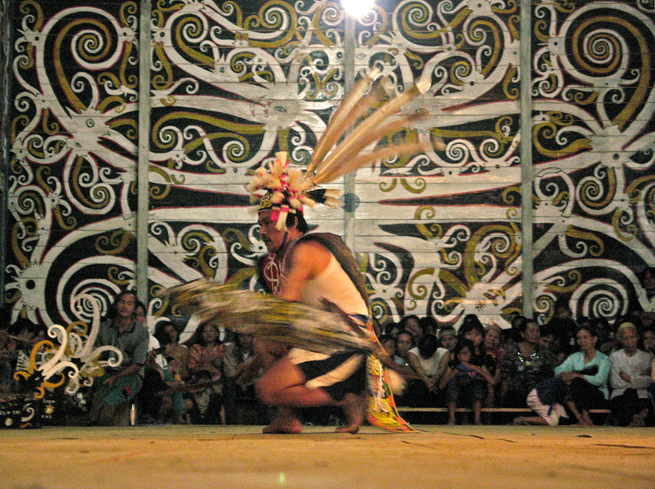
Most Kenyah today are Christian, mainly Evangelical Protestant, but some still follow the Bungan faith, a traditional animist belief system. Before Christianity, Kenyah religious life centered on Adat Pu’un, involving rituals, ancestor veneration, and beliefs in spirits. Music, dance, and art are important in ceremonies and daily life. Traditional dress and musical performances remain vital at festivals, especially the harvest celebration.
The history of the Kenyah
The Kenyah trace their origins to the Usun Apau plateau (Apo Kayan Highlands) on the border of present-day Sarawak and North Kalimantan. Historically, they lived in remote forested areas, migrating over time within Borneo. In the 20th century, some Kenyah moved to new settlements, such as Budaya Pampang near Samarinda, Indonesia, often due to government resettlement or development projects. The Kenyah have maintained their identity through strong clan ties, communal living, and cultural practices.
Kenyah life today
Today, the Kenyah number about 72,000 across Malaysia and Indonesia. Many still live in traditional longhouses, though some have moved to towns or resettlement areas. Christianity is now the main religion, but efforts continue to preserve traditional beliefs and arts. Cultural villages like Budaya Pampang help showcase Kenyah heritage. The community faces pressures from land development and modernization, but their festivals, music, and crafts remain vibrant.
Questions people ask about the Kenyah
Where do the Kenyah live?
The Kenyah live in Malaysia and Indonesia, in the interior forests and highlands of Sarawak and East Kalimantan, Borneo.
How many Kenyah people are there?
Our sources give the Kenyah population as about 72,000 (2023, Malaysia and Indonesia). Counts of peoples vary with who is counted and when.
What language do the Kenyah speak?
The Kenyah speak Kenyah languages, Sarawak Malay, Standard Malay, English, Indonesian, which belongs to the Austronesian family of languages.
How do the Kenyah make a living?
The Kenyah are known for shifting cultivation and settled farming. Like most peoples, they combine several ways of making a living, and these have changed over time.
Sources and further reading
- Kenyah people on WikipediaEncyclopedia
- Encyclopaedia BritannicaArticle
- More photos on Wikimedia CommonsPhotos
- Wikidata recordOpen data
This page was written with AI assistance from the sources above and checked automatically before publishing. It may contain mistakes, and it is no substitute for hearing from the Kenyah themselves. If something is wrong, tell us. Last refreshed 2026-10-02.
Neighbours in Malaysia
All peoples of Malaysia MalaysOrang Melayu
🇲🇾 Malaysia and 4 moreAustronesian people of the Malay Peninsula, Sumatra, Borneo and nearby islands
About 30 million, Austronesian
MalaysOrang Melayu
🇲🇾 Malaysia and 4 moreAustronesian people of the Malay Peninsula, Sumatra, Borneo and nearby islands
About 30 million, Austronesian
 Minangkabaubangso Minangkabau
🇮🇩 Indonesia and 3 moreMatrilineal Muslim society from the highlands of West Sumatra
About 6.6 million, Austronesian
Minangkabaubangso Minangkabau
🇮🇩 Indonesia and 3 moreMatrilineal Muslim society from the highlands of West Sumatra
About 6.6 million, Austronesian
 Sundaneseᮅᮛᮀ ᮞᮥᮔ᮪ᮓ (Urang Sunda)
🇮🇩 Indonesia and 3 moreThe native people of western Java, Indonesia, known for their language and traditions
About 42 million, Austronesian
Sundaneseᮅᮛᮀ ᮞᮥᮔ᮪ᮓ (Urang Sunda)
🇮🇩 Indonesia and 3 moreThe native people of western Java, Indonesia, known for their language and traditions
About 42 million, Austronesian
 Sama-BajauSama
🇵🇭 Philippines and 3 moreSeafaring Austronesian people of the southern Philippines, Borneo, and eastern Indonesia
About 1.3 million, Austronesian
Sama-BajauSama
🇵🇭 Philippines and 3 moreSeafaring Austronesian people of the southern Philippines, Borneo, and eastern Indonesia
About 1.3 million, Austronesian
Other Austronesian speakers
See them all Balineseanak Bali
🇮🇩 IndonesiaHindu-majority people of Bali, known for art, dance, and water-temple farming
About 3.9 million, Austronesian
Balineseanak Bali
🇮🇩 IndonesiaHindu-majority people of Bali, known for art, dance, and water-temple farming
About 3.9 million, Austronesian
 TorajaTo Raya
🇮🇩 IndonesiaHighland people of South Sulawesi known for elaborate funerals and tongkonan houses
About 1.1 million, Austronesian
TorajaTo Raya
🇮🇩 IndonesiaHighland people of South Sulawesi known for elaborate funerals and tongkonan houses
About 1.1 million, Austronesian
 MadureseOrèng Mâdhurâ
🇮🇩 Indonesia and 2 moreCattle herders and satay makers from Madura Island and eastern Java
About 7.2 million, Austronesian
MadureseOrèng Mâdhurâ
🇮🇩 Indonesia and 2 moreCattle herders and satay makers from Madura Island and eastern Java
About 7.2 million, Austronesian
 IbanDayak Iban
🇲🇾 Malaysia and 2 moreDayak people of northwestern Borneo, known for longhouses and weaving
About 740,000, Austronesian
IbanDayak Iban
🇲🇾 Malaysia and 2 moreDayak people of northwestern Borneo, known for longhouses and weaving
About 740,000, Austronesian