
Apache
They call themselves Indé
Southern Athabaskan-speaking peoples of the US Southwest and northern Mexico
The Apache are a group of Southern Athabaskan-speaking peoples whose homelands span the southwestern United States and northern Mexico. Today, they live mainly in Arizona, New Mexico, Texas, Oklahoma, and the Mexican states of Sonora, Chihuahua, Coahuila, and Tamaulipas. Apache tribes are known for their distinct languages, autonomous bands, and a history of resistance to colonization.
- Apache tribes are politically autonomous and self-governing.
- They speak several Southern Athabaskan languages.
- Their homelands span the US Southwest and northern Mexico.
- Apache history includes centuries of resistance to colonization.
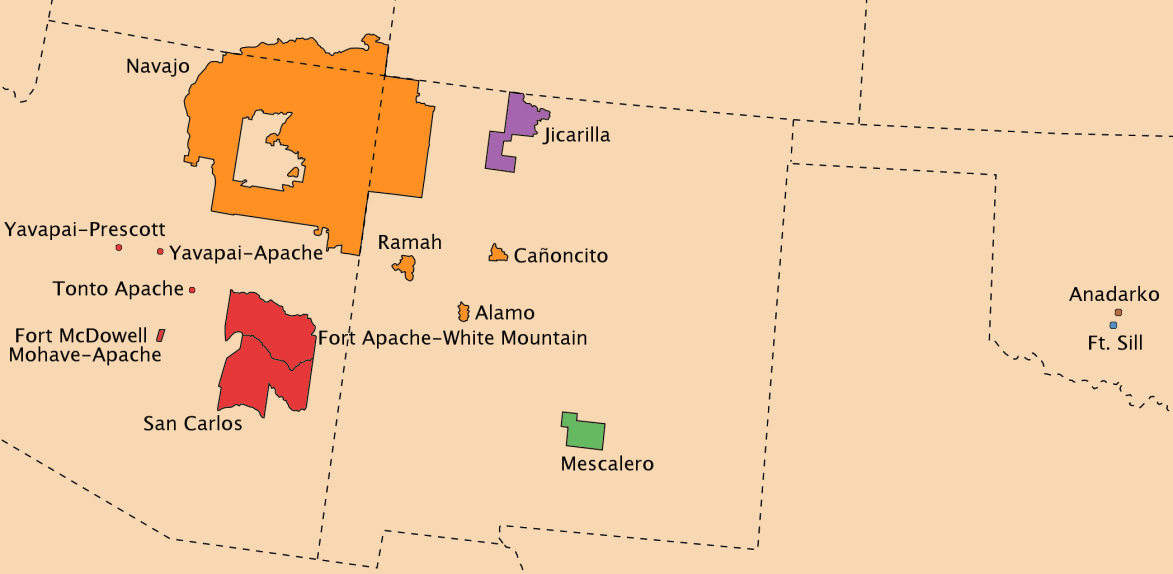
- Many Apache live on reservations in Arizona, New Mexico, Texas, and Oklahoma.
Who are the Apache?
The Apache are not a single tribe but a group of related peoples who speak Southern Athabaskan languages. They are organized into several major groups and many bands, including the Chiricahua, Jicarilla, Lipan, Mescalero, Plains, and Western Apache. Each group maintains its own traditions, leadership, and identity. What holds them together is a shared language family, a long history in the Southwest and northern Mexico, and a sense of kinship through clan and band ties. Apache identity is shaped by both their own traditions and the challenges of colonization and reservation life.
Where do the Apache live?
Apache homelands stretch across the high mountains, valleys, canyons, deserts, and southern plains of the southwestern United States and northern Mexico. This region, sometimes called Apacheria, includes present-day Arizona, New Mexico, Texas, Oklahoma, and the Mexican states of Sonora, Chihuahua, Coahuila, and Tamaulipas. The land is varied, with sheltered valleys and rugged mountains providing resources and protection. Today, Apache reservations are found mainly in Arizona, New Mexico, Oklahoma, and Texas.
What language do the Apache speak?
The Apache speak several closely related Southern Athabaskan languages, including Jicarilla, Plains Apache, Lipan, Mescalero-Chiricahua, and Western Apache. Many Apache people also speak English and Spanish. While some languages are still spoken, English and Spanish are often used in daily life. Language preservation efforts continue in many communities.
How do the Apache live?
Traditionally, Apache people relied on foraging, hunting, and gathering wild plants, as well as farming and herding where possible. Some groups practiced small-scale agriculture and kept livestock. Fishing was important in some areas. Apache crafts include basketry, beadwork, and tool-making. Today, many Apache also work in towns, on reservations, or in tribal enterprises, combining traditional and modern livelihoods.
How is Apache society organised?
Apache society is organized into bands and clans, with kinship and descent playing a central role. Leadership is often based on consensus and the respect earned by elders and skilled individuals. Marriage rules and clan membership vary among groups. Each tribe is politically autonomous, making its own decisions about governance, land, and community life.


What do the Apache believe?
Apache religious life blends traditional beliefs, such as shamanism and ceremonies tied to the land, with Christianity and the Native American Church. Rituals, songs, and dances are important for marking life events and maintaining community ties. Art and dress reflect both tradition and adaptation, with beadwork and basketry being notable crafts.
The history of the Apache
The Apache migrated into the Southwest from the north between 1000 and 1500 CE. They resisted Spanish, Mexican, and later American colonization, often through warfare and strategic alliances. The Apache were known for their skill in battle and their ability to adapt to changing conditions. In the 19th century, many were forced onto reservations after years of conflict. Some groups, like the Chiricahua, were held as prisoners of war before being relocated. Despite these hardships, Apache communities have maintained their identity and traditions.
Apache life today
Today, Apache people live mainly on reservations in the United States and in communities in northern Mexico. Their numbers are estimated at nearly 200,000, with smaller populations in Canada. Apache tribes are federally recognized in the US and govern their own affairs. They continue to face challenges related to land, language, and cultural preservation, but also work to revive traditions and strengthen community ties.
Questions people ask about the Apache
Where do the Apache live today?
Most Apache live on reservations in Arizona, New Mexico, Texas, and Oklahoma in the United States, and in the Mexican states of Sonora, Chihuahua, Coahuila, and Tamaulipas.
How many Apache people are there?
There are about 194,715 self-identified Apache, with smaller populations in Mexico and Canada.
What language do the Apache speak?
Apache people speak several Southern Athabaskan languages, including Jicarilla, Plains Apache, Lipan, Mescalero-Chiricahua, and Western Apache. Many also speak English and Spanish.
What are the main Apache tribes or groups?
The main Apache groups are the Chiricahua, Jicarilla, Lipan, Mescalero, Plains, and Western Apache, each with its own bands and traditions.
What religions or beliefs do the Apache follow?
Apache beliefs include traditional shamanism, the Native American Church, Christianity, and Indigenous religion.
Sources and further reading
This page was written with AI assistance from the sources above and checked automatically before publishing. It may contain mistakes, and it is no substitute for hearing from the Apache themselves. If something is wrong, tell us. Last refreshed 2026-10-02.
Neighbours in the United States
All peoples of the United States NavajoDiné
🇺🇸 United StatesThe largest Native American nation, spanning Arizona, New Mexico, and Utah
About 399,000, Athabaskan
NavajoDiné
🇺🇸 United StatesThe largest Native American nation, spanning Arizona, New Mexico, and Utah
About 399,000, Athabaskan
 Jewsיהודים
🇮🇱 Israel and 11 moreAn ethnoreligious group with ancient roots in Israel and a global presence today
About 15 million
Jewsיהודים
🇮🇱 Israel and 11 moreAn ethnoreligious group with ancient roots in Israel and a global presence today
About 15 million
 Uyghursئۇيغۇرلار / Уйғурлар / Uyghurlar
🇨🇳 China and 12 moreA Turkic people of Xinjiang, China, with deep roots in Central Asia
About 12 million, Turkic (Karluk branch)
Uyghursئۇيغۇرلار / Уйғурлар / Uyghurlar
🇨🇳 China and 12 moreA Turkic people of Xinjiang, China, with deep roots in Central Asia
About 12 million, Turkic (Karluk branch)
 Palestiniansفلسطينيون
🇵🇸 Palestine and 8 moreAn Arab people native to Palestine, with a large diaspora worldwide
About 14 million, Semitic
Palestiniansفلسطينيون
🇵🇸 Palestine and 8 moreAn Arab people native to Palestine, with a large diaspora worldwide
About 14 million, Semitic