
Acehnese
They call themselves Ureueng Acèh
Austronesian Muslim people native to Aceh, northern Sumatra
The Acehnese are an Austronesian ethnic group native to Aceh, at the northern tip of Sumatra, Indonesia. Numbering between 3.5 and 4.2 million, they are known for their strong Islamic traditions, history of resistance to colonial rule, and vibrant communal life.
- Native to Aceh, northern Sumatra, Indonesia
- Speak the Acehnese language, part of the Austronesian family
- Predominantly Sunni Muslim for centuries
- Traditionally live in communal villages called gampôngs
- Known for resistance to Dutch colonial rule
Who are the Acehnese?
The Acehnese are an Austronesian people who trace their roots to Aceh, the northernmost province of Sumatra in Indonesia. Their identity is shaped by a shared language, Acehnese, and a strong Islamic faith. Acehnese society is traditionally communal, with people living in villages called gampôngs that join to form larger districts. Their history includes centuries of trade, migration, and cultural blending, and they are known for their resilience and communal values.
Where do the Acehnese live?
Aceh lies at the far north of Sumatra, bordered by the Indian Ocean and the Malacca Strait. The region is rich in fertile valleys, rivers, and coastal plains. Its strategic location has made it a crossroads for traders from India, the Middle East, and Southeast Asia for centuries. The land supports rice farming and pepper cultivation, and its position on the sea route has influenced both its culture and population.
What language do the Acehnese speak?
Acehnese is part of the Aceh–Chamic branch of the Malayo-Polynesian languages within the Austronesian family. It is closely related to languages spoken in Cambodia and Vietnam. The language has absorbed words from Sanskrit, Arabic, Malay, and Mon-Khmer languages, reflecting centuries of contact and migration. Several dialects exist, especially in Aceh Besar and Pidie regions.
How do the Acehnese live?
Traditionally, the Acehnese make their living through settled agriculture, especially rice and pepper farming. They are also skilled metalworkers and weavers, producing textiles and crafts. Communal work is common, and villages are organized to support collective farming and irrigation. Houses are typically built on stilts and made of wood, suited to the local climate and landscape.
How is Acehnese society organised?
Acehnese society is matrilocal, meaning that after marriage, men often move to live with their wife's family. Social organization is communal, centered on the gampông (village), which is the basic unit of daily life. Several gampôngs form a mukim, or district. Decision-making is collective, and customary law (adat) plays a strong role. Family ties and respect for elders are important social values.



What do the Acehnese believe?
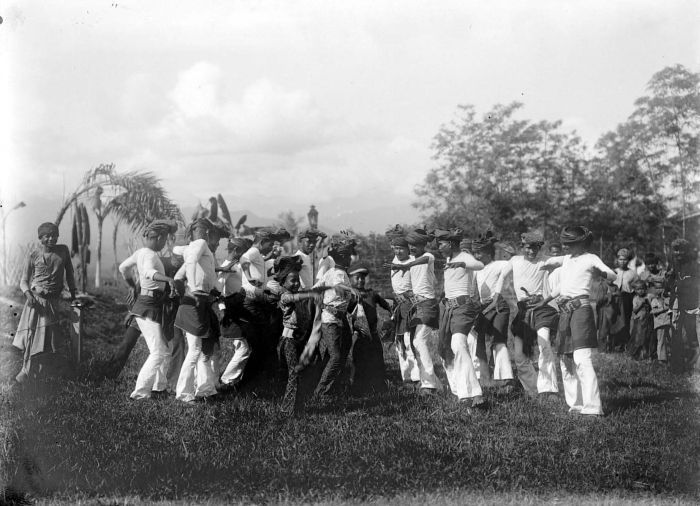
The Acehnese are predominantly Sunni Muslims, and Islam shapes their daily lives, rituals, and festivals. Their culture also retains traces of earlier Hindu and Buddhist influences, seen in traditions and vocabulary. Religious scholars (ulama) are highly respected, and Aceh has long been a center of Islamic learning. Traditional arts include weaving, music, and ceremonies, especially in weddings and communal gatherings.
The history of the Acehnese
Aceh has been inhabited since the Pleistocene, with early populations relying on seafood and land animals. Over centuries, migrations from Proto-Malay, Deutero-Malay, Indian, Arab, Persian, and Turkish peoples shaped the Acehnese. The region became an Islamic center by the 13th century, with the Aceh Sultanate rising to prominence in the 16th and 17th centuries. Acehnese resisted Portuguese and Dutch colonial rule fiercely. In modern times, Aceh suffered greatly in the 2004 Indian Ocean tsunami.
Acehnese life today
Today, the Acehnese number between 3.5 and 4.2 million, mainly in Aceh, Indonesia, with communities in Malaysia. They maintain strong Islamic traditions and communal ways of life, though modern pressures and migration have brought change. The 2004 tsunami had a deep impact, but Acehnese society continues to rebuild and preserve its cultural identity.
Questions people ask about the Acehnese
Where do the Acehnese live?
The Acehnese mainly live in Aceh province at the northern tip of Sumatra, Indonesia, with some communities in Malaysia.
How many Acehnese are there?
There are between 3.5 and 4.2 million Acehnese people, according to recent estimates.
What language do the Acehnese speak?
The Acehnese speak the Acehnese language, which belongs to the Aceh–Chamic branch of the Austronesian language family.
What is the main religion of the Acehnese?
The vast majority of Acehnese are Sunni Muslims, and Islam is central to their culture and daily life.
What are the traditional ways of life for the Acehnese?
Traditionally, the Acehnese are farmers, metalworkers, and weavers, living in communal villages and practicing matrilocal residence.
Sources and further reading
- Acehnese people on WikipediaEncyclopedia
- Encyclopaedia BritannicaArticle
- More photos on Wikimedia CommonsPhotos
- Wikidata recordOpen data
This page was written with AI assistance from the sources above and checked automatically before publishing. It may contain mistakes, and it is no substitute for hearing from the Acehnese themselves. If something is wrong, tell us. Last refreshed 2026-10-02.
Neighbours in Indonesia
All peoples of Indonesia MalaysOrang Melayu
🇲🇾 Malaysia and 4 moreAustronesian people of the Malay Peninsula, Sumatra, Borneo and nearby islands
About 30 million, Austronesian
MalaysOrang Melayu
🇲🇾 Malaysia and 4 moreAustronesian people of the Malay Peninsula, Sumatra, Borneo and nearby islands
About 30 million, Austronesian
 Minangkabaubangso Minangkabau
🇮🇩 Indonesia and 3 moreMatrilineal Muslim society from the highlands of West Sumatra
About 6.6 million, Austronesian
Minangkabaubangso Minangkabau
🇮🇩 Indonesia and 3 moreMatrilineal Muslim society from the highlands of West Sumatra
About 6.6 million, Austronesian
 Sundaneseᮅᮛᮀ ᮞᮥᮔ᮪ᮓ (Urang Sunda)
🇮🇩 Indonesia and 3 moreThe native people of western Java, Indonesia, known for their language and traditions
About 42 million, Austronesian
Sundaneseᮅᮛᮀ ᮞᮥᮔ᮪ᮓ (Urang Sunda)
🇮🇩 Indonesia and 3 moreThe native people of western Java, Indonesia, known for their language and traditions
About 42 million, Austronesian
 BugisTo Ugi
🇮🇩 Indonesia and 2 moreRice farmers, traders and sailors of South Sulawesi and beyond
About 7 million, Austronesian (South Sulawesi languages)
BugisTo Ugi
🇮🇩 Indonesia and 2 moreRice farmers, traders and sailors of South Sulawesi and beyond
About 7 million, Austronesian (South Sulawesi languages)