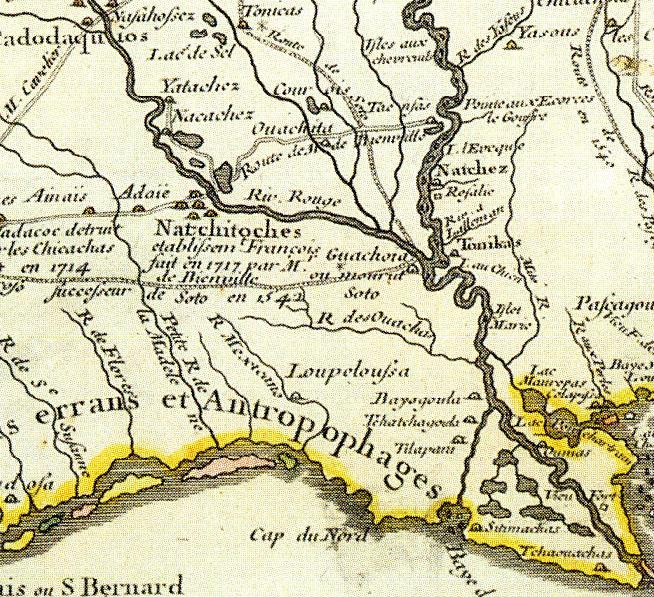
Adai
A Southeastern Woodlands people of Louisiana and Texas, now merged with the Caddo
The Adai were an Indigenous people of northwestern Louisiana and northeastern Texas, once part of the Caddo Confederacy. Their language is extinct and unclassified, and by the early 1800s, most Adai had merged with the Caddo or other local tribes. Today, their descendants are recognized as part of the Adai Caddo Indians of Louisiana.
- Lived along the Red River in Louisiana and Texas
- Spoke an unclassified, now extinct language
- Merged with the Caddo by the early 1800s
- Known for distinctive bone-tempered pottery
- Some joined Spanish missions in the 1700s
Who were the Adai?
The Adai were an Indigenous people of the Southeastern Woodlands, living in what is now northwestern Louisiana and northeastern Texas. They were closely linked to other Caddo-speaking peoples and were considered part of the Caddo Confederacy. The Adai were known for their distinct language and pottery styles. Over time, conflict, disease, and assimilation led to their merging with neighboring tribes, especially the Caddo. Today, their descendants are recognized as the Adai Caddo Indians of Louisiana.
Where did the Adai live?
The Adai lived along the Red River, in a region of forests, rivers, and fertile land spanning northwestern Louisiana and northeastern Texas. This area provided abundant resources for farming, fishing, and gathering. The landscape included river valleys, woodlands, and prairies, which shaped the Adai’s way of life and settlement patterns. Archaeological sites in this region have revealed distinctive Adai pottery and village remains.
What language did the Adai speak?
The Adai spoke the Adai language, which is now extinct. Scholars have not been able to classify it with certainty; it may have been a language isolate, unrelated to neighboring tongues. Only a small list of Adai words survives, and early observers noted its difficulty and uniqueness. Today, no fluent speakers remain, and the language is not in use.
How did the Adai live?
The Adai made their living through a mix of farming, fishing, and foraging. They grew crops in the fertile river valleys, gathered wild plants, and fished in the Red River and nearby streams. Their villages were built near water sources, and they crafted pottery with distinctive bone tempering, known as Patton Engraved and Emory Incised types. Tools and daily life reflected the resources of their woodland environment.
How was Adai society organised?
Adai society was organized in villages along the Red River. They were part of the larger Caddo Confederacy, which linked several related tribes. Family and kinship ties were important, and some Adai joined Spanish missions, where they encountered new social and religious structures. Over time, as their numbers declined, surviving families merged with other Caddo groups.
What did the Adai believe?
The Adai practiced Indigenous religious traditions, which included rituals and beliefs tied to the land and seasons. With the arrival of Spanish missionaries in the 18th century, some Adai converted to Roman Catholicism. Pottery and other crafts played a role in their cultural expression. Music, art, and dress details are not well documented in surviving sources.
The history of the Adai
The Adai were among the first Native peoples in the region to encounter Europeans, with contact dating to the 16th century. Spanish and French explorers, missionaries, and traders interacted with the Adai, sometimes leading to conflict. The Spanish established missions to convert the Adai and other Caddoans, but warfare, disease, and alcohol devastated their population. By the late 18th and early 19th centuries, only a few Adai families remained, and most merged with the Caddo or other local tribes.
What became of the Adai?
Today, the Adai no longer exist as a distinct tribe, but their descendants are recognized as the Adai Caddo Indians of Louisiana. The community is based in Robeline, Louisiana. Their history is remembered through archaeological sites, pottery, and the preservation of their name. The Adai’s legacy continues as part of the broader Caddo heritage in the region.
Questions people ask about the Adai
Where did the Adai live?
The Adai lived in northwestern Louisiana and northeastern Texas, mainly along the Red River.
How many Adai people were there?
By 1825, only 27 Adai were recorded, and soon after, they merged with the Caddo and other tribes.
What language did the Adai speak?
They spoke the Adai language, which is now extinct and remains unclassified due to limited records.
What happened to the Adai people?
The Adai suffered from disease, conflict, and assimilation, and by the early 1800s, most had merged with the Caddo.
Are there Adai descendants today?
Yes, their descendants are recognized as the Adai Caddo Indians of Louisiana, based in Robeline.
Sources and further reading
This page was written with AI assistance from the sources above and checked automatically before publishing. It may contain mistakes, and it is no substitute for hearing from the Adai themselves. If something is wrong, tell us. Last refreshed 2026-10-02.
Neighbours in the United States
All peoples of the United States Jewsיהודים
🇮🇱 Israel and 11 moreAn ethnoreligious group with ancient roots in Israel and a global presence today
About 15 million
Jewsיהודים
🇮🇱 Israel and 11 moreAn ethnoreligious group with ancient roots in Israel and a global presence today
About 15 million
 Uyghursئۇيغۇرلار / Уйғурлар / Uyghurlar
🇨🇳 China and 12 moreA Turkic people of Xinjiang, China, with deep roots in Central Asia
About 12 million, Turkic (Karluk branch)
Uyghursئۇيغۇرلار / Уйғурлар / Uyghurlar
🇨🇳 China and 12 moreA Turkic people of Xinjiang, China, with deep roots in Central Asia
About 12 million, Turkic (Karluk branch)
 Palestiniansفلسطينيون
🇵🇸 Palestine and 8 moreAn Arab people native to Palestine, with a large diaspora worldwide
About 14 million, Semitic
Palestiniansفلسطينيون
🇵🇸 Palestine and 8 moreAn Arab people native to Palestine, with a large diaspora worldwide
About 14 million, Semitic
 AssyriansĀṯūrāyē / Suryoye / Suryāyē
🇮🇶 Iraq and 14 moreAn indigenous Christian people of northern Mesopotamia, speaking Neo-Aramaic.
About 1.2 million, Semitic
AssyriansĀṯūrāyē / Suryoye / Suryāyē
🇮🇶 Iraq and 14 moreAn indigenous Christian people of northern Mesopotamia, speaking Neo-Aramaic.
About 1.2 million, Semitic