
Guarani
They call themselves Abá
Indigenous people of Paraguay, Argentina, Brazil, and Bolivia, known for their language and myths
The Guarani are an indigenous people of South America, mainly living in Paraguay, Argentina, Brazil, and Bolivia. Numbering around 280,000–390,000, they are known for their Guarani language, rich mythology, and a history shaped by colonization and mission settlements.
Who are the Guarani?
The Guarani are a group of culturally related indigenous peoples of South America. They are united by the Guarani language and a shared heritage of myths, customs, and community life. Traditionally, Guarani communities are organized around extended families and communal houses, with leadership by chiefs. Their identity is shaped by both their pre-colonial traditions and the profound impacts of European colonization, which included mission settlements and the spread of Christianity. Today, they remain a distinct people, recognized for their language and cultural resilience.
Where do the Guarani live?
The Guarani homeland covers a broad region of central South America. Their traditional lands include much of present-day Paraguay, especially the area between the Paraná and lower Paraguay Rivers, as well as the Misiones Province in Argentina, southern Brazil, and parts of eastern Bolivia. These lands are characterized by forests, rivers, and fertile plains, which have long supported their agricultural and foraging lifestyle. The Iguazu Falls, located on the border of Argentina and Brazil, are especially sacred in Guarani tradition.
What language do the Guarani speak?
Guarani is a Tupi–Guarani language and remains widely spoken among the Guarani people, especially in Paraguay. It is one of the two official languages of Paraguay, used in daily life, education, and government. Many Guarani also speak Spanish or Portuguese, depending on their country. The language is a key part of their identity and cultural continuity, with many myths and oral traditions preserved in Guarani.
How do the Guarani live?
Traditionally, the Guarani have been sedentary farmers, growing crops such as manioc and maize, and supplementing their diet with wild game and honey. They lived in communal houses that sheltered several families. Today, many Guarani continue to farm and forage, though some have been drawn into wage labor or crafts due to land loss and economic pressures. Their traditional tools and houses reflect adaptation to the forest and river environments.
How is Guarani society organised?
Guarani society is organized around extended families living together in communal houses. Leadership is provided by chiefs, and communities often form larger tribal groups based on dialect and kinship. Polygamy was practiced in the past. Marriage and alliances were important for social cohesion. Decision-making is traditionally collective, with elders and chiefs playing key roles. Community life is shaped by shared rituals, stories, and respect for elders.


What do the Guarani believe?
Guarani beliefs combine Christianity—mainly Catholicism and Protestantism—with enduring traditional practices and animism. Their mythology is rich, featuring a pantheon of gods like Ñamandu and Tupã, as well as spirits and animal beings. The Iguazu Falls hold special spiritual significance. Rituals, music, and oral storytelling remain important. Myths explain the origins of plants, animals, and natural features, and many are still told in rural communities.
The history of the Guarani
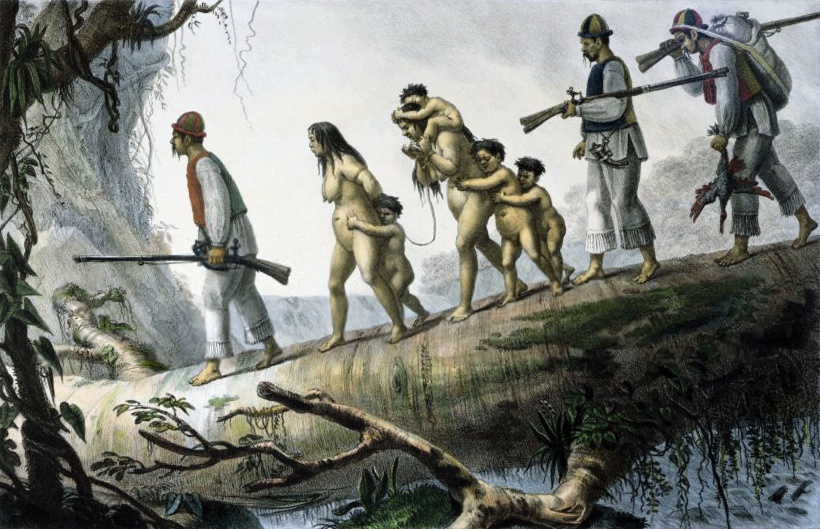
Before European contact, the Guarani numbered around 400,000 and lived in settled agricultural villages. Spanish and Portuguese colonization brought violence, forced labor, and the spread of Christianity. Jesuit missions, or reductions, reorganized Guarani society and gathered many into mission settlements. These missions protected some Guarani from slave raids but imposed new social and religious structures. Over time, colonization, disease, and intermarriage reduced their numbers and autonomy. Despite these pressures, Guarani culture and language have survived.
Guarani life today
Today, the Guarani live mainly in Paraguay, Argentina, Brazil, and Bolivia. Their population is estimated at 280,000–390,000. Many still speak Guarani and maintain traditional beliefs alongside Christianity. Land loss, economic hardship, and social change challenge their way of life, but efforts to preserve language and culture continue. In Paraguay, Guarani is an official language, reflecting its importance to national identity.
Questions people ask about the Guarani
Where do the Guarani live?
The Guarani live in Paraguay, Argentina, Bolivia and Brazil, in the Paraguay between the Paraná and lower Paraguay Rivers, Misiones in Argentina, southern Brazil, and parts of Bolivia.
How many Guarani people are there?
Our sources give the Guarani population as about 280,000–390,000 (estimates from 2022–2024). Counts of peoples vary with who is counted and when.
What language do the Guarani speak?
The Guarani speak Guarani, which belongs to the Tupi–Guarani family of languages.
How do the Guarani make a living?
The Guarani are known for settled farming and hunting and gathering. Like most peoples, they combine several ways of making a living, and these have changed over time.
Sources and further reading
- Guaraní people on WikipediaEncyclopedia
- Encyclopaedia BritannicaArticle
- More photos on Wikimedia CommonsPhotos
- Wikidata recordOpen data
This page was written with AI assistance from the sources above and checked automatically before publishing. It may contain mistakes, and it is no substitute for hearing from the Guarani themselves. If something is wrong, tell us. Last refreshed 2026-10-02.
Neighbours in Paraguay
All peoples of Paraguay TobaQom
🇦🇷 Argentina and 2 moreA major Indigenous people of the Gran Chaco, Argentina, Paraguay and Bolivia
About 129,000, Guaicuruan
TobaQom
🇦🇷 Argentina and 2 moreA major Indigenous people of the Gran Chaco, Argentina, Paraguay and Bolivia
About 129,000, Guaicuruan
 Ayoreo
🇵🇾 Paraguay and 1 moreNomadic hunter-gatherers of the Gran Chaco, some still living in voluntary isolation
About 6,000, Zamucoan
Ayoreo
🇵🇾 Paraguay and 1 moreNomadic hunter-gatherers of the Gran Chaco, some still living in voluntary isolation
About 6,000, Zamucoan
 Wichí
🇦🇷 Argentina and 2 moreIndigenous forest and river people of Argentina and Bolivia
About 56,000, Matacoan
Wichí
🇦🇷 Argentina and 2 moreIndigenous forest and river people of Argentina and Bolivia
About 56,000, Matacoan
 Mbya Guaranimby’as
🇵🇾 Paraguay and 3 moreA branch of the Guarani living in Paraguay, Brazil, Argentina, and Uruguay
About 34,000, Tupian
Mbya Guaranimby’as
🇵🇾 Paraguay and 3 moreA branch of the Guarani living in Paraguay, Brazil, Argentina, and Uruguay
About 34,000, Tupian
Other Tupi–Guarani speakers
See them all Zo'éZo'és
🇧🇷 BrazilSemi-nomadic Tupi–Guarani people of Pará, Brazil
About 315, Tupi–Guarani
Zo'éZo'és
🇧🇷 BrazilSemi-nomadic Tupi–Guarani people of Pará, Brazil
About 315, Tupi–Guarani
 Guajajara
🇧🇷 BrazilForest guardians of Maranhão in northeastern Brazil
About 28,000, Tupi–Guarani
Guajajara
🇧🇷 BrazilForest guardians of Maranhão in northeastern Brazil
About 28,000, Tupi–Guarani
 WayampiWajãpi
🇧🇷 Brazil and 1 moreIndigenous people of the border forests of Brazil and French Guiana
About 2,000, Tupi–Guarani
WayampiWajãpi
🇧🇷 Brazil and 1 moreIndigenous people of the border forests of Brazil and French Guiana
About 2,000, Tupi–Guarani
 AwáAwa Guajá
🇧🇷 BrazilNomadic hunter-gatherers of the eastern Amazon rainforest in Brazil
About 520, Tupi–Guarani
AwáAwa Guajá
🇧🇷 BrazilNomadic hunter-gatherers of the eastern Amazon rainforest in Brazil
About 520, Tupi–Guarani