
Old Prussians
A Baltic people of the southeastern Baltic coast, known for Old Prussian language and beliefs
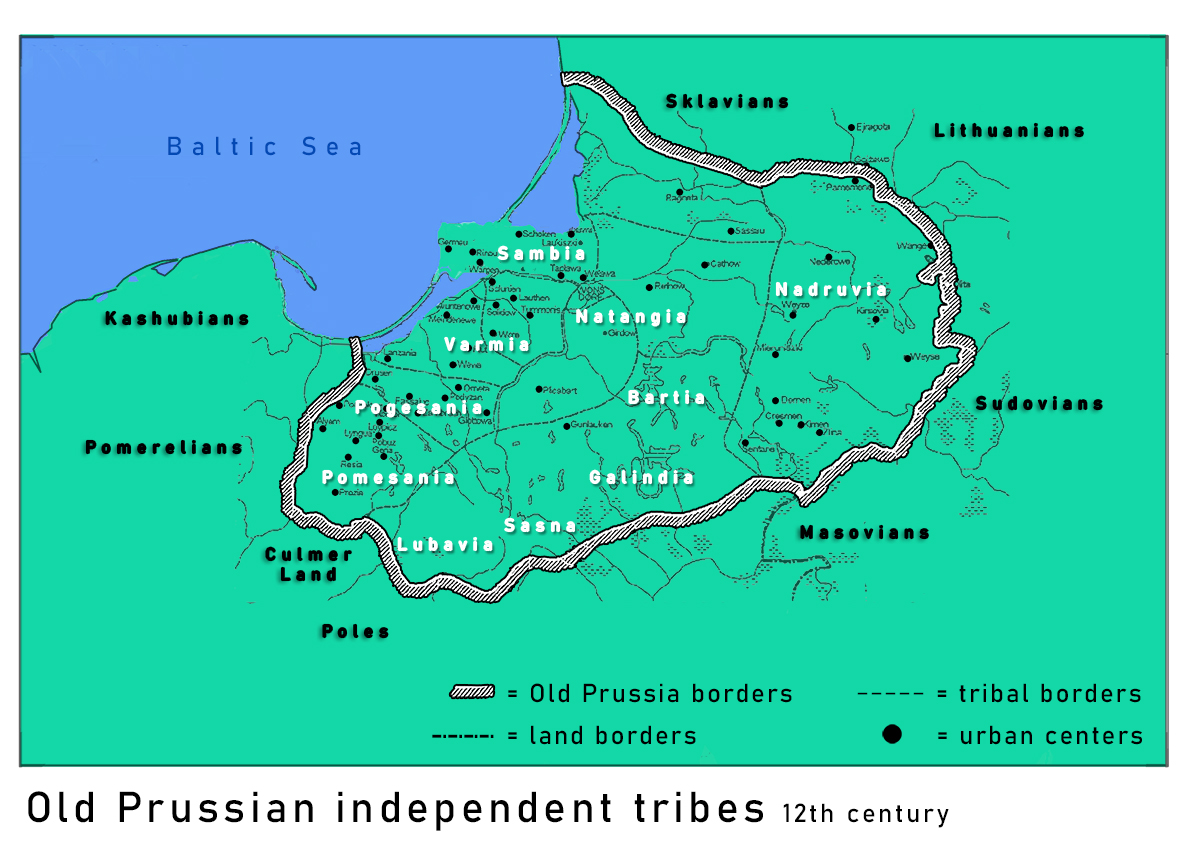
The Old Prussians were a Baltic people who lived between the Vistula and Curonian Lagoons, in what is now parts of Poland, Lithuania, and Russia. They spoke Old Prussian, a Baltic language, and practiced their own traditional religion before being conquered and assimilated after the 13th century. Their language became extinct by the 18th century.
- Lived between the Vistula and Curonian Lagoons on the Baltic coast
- Spoke Old Prussian, a now-extinct Baltic language
- Practiced Baltic paganism before Christianization
- Society organized in clans and hill forts
- Conquered by the Teutonic Order in the 13th century
Who were the Old Prussians?
The Old Prussians were a Baltic people who lived along the southeastern coast of the Baltic Sea, mainly between the Vistula and Curonian Lagoons. They were organized into clans and tribes, each named after their region, such as the Sambians and Bartians. Their society was held together by shared language, customs, and religious beliefs rooted in the natural world. They did not see themselves as a single nation, but as related groups with common traditions.
Where did the Old Prussians live?
Their homeland covered central and southern parts of what are now the Pomeranian and Warmian-Masurian regions of Poland, the Kaliningrad Oblast of Russia, and the southern Klaipėda Region of Lithuania. The land was shaped by lakes, rivers, forests, and wetlands, with settlements separated by stretches of uninhabited land. The region was rich in natural resources, supporting farming and fishing.
What language did the Old Prussians speak?
Old Prussian was a Baltic language, part of the Indo-European family. It is now extinct, with only limited documentation surviving. The language disappeared by the 18th century as the people were assimilated and German became dominant in the region.
How did the Old Prussians live?
The Old Prussians lived by farming and fishing, making use of the fertile land and abundant waterways. Their settlements, called laūks, were family-based and surrounded by fields. They built strongholds or hill forts for protection. Mead was a common drink, and horse products were consumed by the wealthy. They dressed plainly and valued hospitality.
How was Old Prussians society organised?
Society was organized around family groups and clans, each led by a male head of household. Larger groups were governed by gatherings of adult men, who elected leaders and chiefs. The chief oversaw defense and infrastructure. Marriage was often commercial, and polygyny was practiced. Women held limited power and were often treated as subordinates within the household.



What did the Old Prussians believe?
The Old Prussians practiced a form of Baltic paganism, seeing spirits in natural forces like the sun, moon, animals, and sacred groves. They believed in many spirits and an afterlife, and practiced ancestor worship. Priests called Kriwe-Kriwajto and others maintained religious sites and rituals. Burial customs included cremation in urns and grave mounds. Stone statues known as babas are found across their former lands.
The history of the Old Prussians
The Old Prussians resisted early attempts at conquest and Christianization by neighboring powers, including the Polans in the 10th century. In the 13th century, the Teutonic Order conquered and subjugated them, leading to forced Christianization and gradual assimilation. Over the next two centuries, their distinct identity faded as they were absorbed by German-speaking settlers. Their language and many customs disappeared, and by the 18th century, Old Prussian was extinct.
What became of the Old Prussians?
The Old Prussians no longer exist as a distinct people. Their descendants were assimilated into other populations, and their language and traditions have vanished. The region they once inhabited is now divided among Poland, Lithuania, and Russia. Some archaeological sites and cultural traces remain, studied by historians and archaeologists.
Questions people ask about the Old Prussians
Where did the Old Prussians live?
They lived along the southeastern Baltic coast, mainly in areas now part of Poland, Lithuania, and Russia, between the Vistula and Curonian Lagoons.
How many Old Prussians were there?
The sources do not give a specific population number for the Old Prussians.
What language did the Old Prussians speak?
They spoke Old Prussian, a Baltic language related to Lithuanian and Latvian, which is now extinct.
What happened to the Old Prussians?
They were conquered by the Teutonic Order in the 13th century and gradually assimilated, losing their language and distinct identity by the 18th century.
What did the Old Prussians believe in?
They practiced a form of Baltic paganism, worshipping natural forces and spirits, and later some converted to Catholicism after conquest.
Sources and further reading
This page was written with AI assistance from the sources above and checked automatically before publishing. It may contain mistakes, and it is no substitute for hearing from the Old Prussians themselves. If something is wrong, tell us. Last refreshed 2026-10-02.
Neighbours in Poland
All peoples of Poland Rusyns
🇺🇦 Ukraine and 11 moreEast Slavic people native to the Carpathian Mountains
About 1.8 million, East Slavic
Rusyns
🇺🇦 Ukraine and 11 moreEast Slavic people native to the Carpathian Mountains
About 1.8 million, East Slavic
 Crimean Karaites
🇺🇦 Ukraine and 6 moreA Turkic-speaking Karaite Jewish community native to Crimea and Eastern Europe
About 2,000, Turkic (Kipchak branch)
Crimean Karaites
🇺🇦 Ukraine and 6 moreA Turkic-speaking Karaite Jewish community native to Crimea and Eastern Europe
About 2,000, Turkic (Kipchak branch)
 Vistulans
🇵🇱 PolandEarly medieval tribe of the western Vistula valley in Lesser Poland
Historical
Vistulans
🇵🇱 PolandEarly medieval tribe of the western Vistula valley in Lesser Poland
Historical
 Great Lithuanians
🇱🇹 Lithuania and 3 moreNobles of the Grand Duchy of Lithuania, later Polonized in culture and language
Historical
Great Lithuanians
🇱🇹 Lithuania and 3 moreNobles of the Grand Duchy of Lithuania, later Polonized in culture and language
Historical
