
Bunak
They call themselves Gaiq
Mountain people of central Timor speaking a Papuan language
The Bunak are an indigenous people living in the mountainous heart of central Timor, divided between East Timor and West Timor (Indonesia). Numbering around 76,000, they speak the Bunak language, which is Papuan and distinct from the Austronesian languages of their neighbors. They are known for their oral traditions and mixed Catholic and animist beliefs.
- Speak a Papuan language distinct from neighbors
- Live in mountain villages of central Timor
- Number about 76,000 across Indonesia and East Timor
- Maintain strong oral traditions and myths
- Blend Catholic and traditional beliefs
Who are the Bunak?
The Bunak are an indigenous people of central Timor, living in both East Timor and West Timor (Indonesia). They are united by their distinct Papuan language, Bunak, and by shared oral traditions, beliefs, and customs. Their communities are often found in mountainous, hard-to-reach areas, which has helped preserve their language and ways of life. Despite being surrounded by groups who speak Austronesian languages, the Bunak maintain a strong sense of identity through their language, stories, and rituals passed down through generations.
Where do the Bunak live?
The Bunak homeland stretches across the central mountains of Timor, from the town of Maliana in the north to the Timor Sea in the south. Their villages are often isolated, set in rugged terrain that makes travel and communication with neighboring groups difficult. In East Timor, they are concentrated in Bobonaro, Cova Lima, Ainaro, and Manufahi districts, while in West Timor they are found mainly in the Lamaknen and Malaka regions. The landscape is marked by steep hills, forests, and scattered fields.
What language do the Bunak speak?
The Bunak language is a Papuan language, part of the Trans–New Guinea family, and is distinct from the Austronesian languages spoken by neighboring peoples. Most Bunak are multilingual, often speaking Tetum or Indonesian as well, but their own language remains central to their identity. Bunak is still widely spoken in their villages, though neighboring groups rarely learn it. The language shows influences from Kemak and other local languages.
How do the Bunak live?
The Bunak traditionally make their living by farming, cultivating crops on the mountain slopes. Their villages are built to suit the hilly terrain, with houses often raised above the ground. Farming is central to their diet and economy, and the search for new arable land has shaped their migrations over time. In addition to farming, they keep livestock such as water buffalo, which also play a role in their stories and rituals.
How is Bunak society organised?
Bunak society is organized around extended families and local communities. Oral traditions, including myths and genealogies, are important for maintaining social ties and passing on knowledge. Marriage and kinship rules are shaped by custom, and leadership is often exercised by elders or respected figures. Decisions are made collectively, with a strong emphasis on tradition and consensus.


What do the Bunak believe?
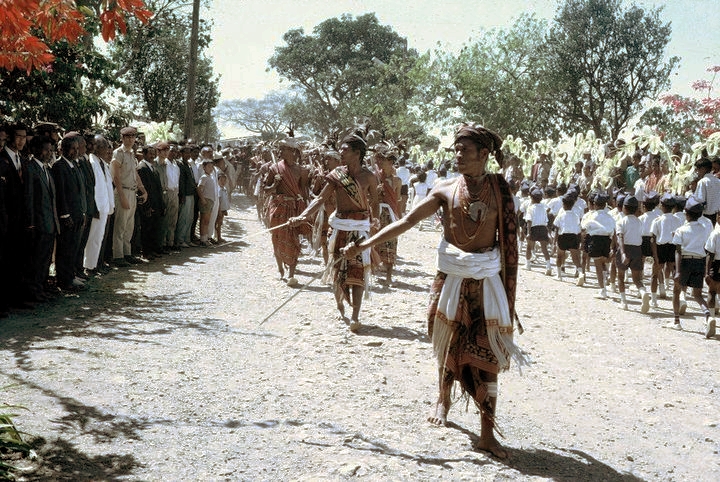
Most Bunak today are Catholic, a result of missionary activity during the colonial era, but many traditional animist beliefs and rituals remain important. They hold ceremonies in sacred houses, called Uma Lulik, and maintain stories about their origins and ancestors. Oral storytelling, music, and ritual are central to their cultural life. Dress and adornment often reflect both Catholic and traditional influences.
The history of the Bunak
The Bunak are thought to have settled central Timor before the arrival of Austronesian-speaking peoples. Oral traditions trace their ancestry to legendary figures and migrations. Their homeland was divided by colonial borders in the 18th century, with the west under Dutch and the east under Portuguese control. During World War II, Timor was occupied by Japan. After the war, West Timor became part of Indonesia, while East Timor remained a Portuguese colony until 1975. The Indonesian invasion of East Timor in 1975 led to decades of conflict, with many Bunak fleeing to the mountains. East Timor regained independence in 2002, but the Bunak homeland remains divided.
Bunak life today
Today, the Bunak number about 76,000, with most living in rural mountain villages and some moving to cities like Dili. They continue to farm and maintain their language and traditions, though pressures from migration, modernization, and the legacy of conflict have brought change. Their homeland remains split by the Indonesia–East Timor border, but Bunak communities maintain ties across it.
Questions people ask about the Bunak
Where do the Bunak live?
The Bunak live in the mountainous region of central Timor, with communities in both East Timor and West Timor (Indonesia), especially in districts like Bobonaro, Cova Lima, and Lamaknen.
How many Bunak people are there?
There are about 76,000 Bunak people, with around 55,800 in East Timor (2010) and 23,000 in West Timor.
What language do the Bunak speak?
They speak the Bunak language, which is a Papuan language of the Trans–New Guinea family, different from the Austronesian languages spoken by most of their neighbors.
What are the main beliefs of the Bunak?
Most Bunak are Catholic, but they also keep many traditional animist beliefs and rituals, especially those involving ancestors and sacred houses.
How do the Bunak make a living?
The Bunak mainly farm crops on mountain slopes and keep livestock such as water buffalo, which are important in their economy and stories.
Sources and further reading
This page was written with AI assistance from the sources above and checked automatically before publishing. It may contain mistakes, and it is no substitute for hearing from the Bunak themselves. If something is wrong, tell us. Last refreshed 2026-10-02.